
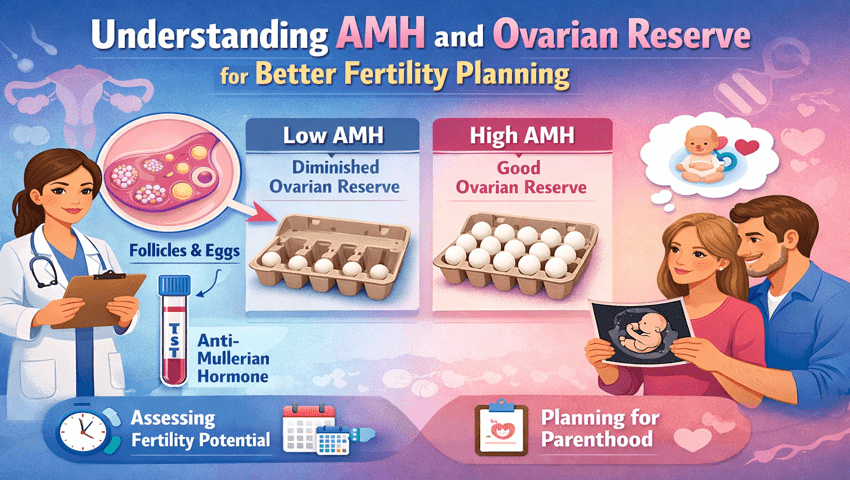
Important to know, a woman is born with a fixed number of eggs, and this number gradually decreases with age. Over time, not only does the quantity reduce, but the quality of eggs also declines. Ovarian reserve refers to the remaining number of healthy eggs in the ovaries, which plays a key role in a woman’s fertility and chances of conception. Understanding AMH and ovarian reserve is important for evaluating fertility health. Consulting the best gynecologist in Punawale can help you understand your fertility health at the right time.
Planning pregnancy after 30? You are not alone. Today, many women choose to focus on career, stability, or personal goals before starting a family. That’s why fertility planning has become more important than ever, and knowing about AMH and ovarian reserve can support better decision-making.
One of the most important tests, the AMH test, also known as the egg count test, is commonly recommended today. This test helps measure your ovarian reserve, which means the number of eggs remaining in your ovaries, making AMH and ovarian reserve key indicators of fertility health.
More women are checking their AMH levels to understand their fertility health early and make informed decisions about pregnancy.
What Is AMH?
AMH stands for Anti-Müllerian Hormone.
It is a hormone produced by small follicles (tiny sacs) in the ovaries that contain immature eggs. The level of AMH in your blood gives an idea of your egg reserve.
- It is a simple blood test.
- It can be done on any day of your menstrual cycle.
- It helps doctors estimate your remaining egg supply.
In Simple Terms:
Higher AMH:
- Usually means you have a good number of eggs
- It is common in younger women.
- Very high AMH levels are sometimes seen in PCOS and may cause irregular ovulation.
Lower AMH:
- Means your egg reserve is reduced.
- It is common for age to increase, especially after 35.
- It does not mean you cannot get pregnant, but it may indicate the need for early fertility planning.
The AMH test does not measure egg quality, but gives a good estimate of egg quantity
Normal AMH Levels by Age (General Guide):
AMH levels naturally decline with age. Here’s a general reference:
- 20–25 years: 3.0 – 6.5 ng/mL
- 26–30 years: 2.5 – 5.0 ng/mL
- 31–35 years: 1.5 – 4.0 ng/mL
- 36–40 years: 1.0 – 3.0 ng/mL
- 41–45 years: 0.5 – 2.0 ng/mL
Normal AMH level (overall):
- 1.0 – 4.0 ng/mL is generally considered normal
- Below 1.0 → Low ovarian reserve
- Above 4.0 → May indicate PCOS
Note: AMH ranges may vary depending on the laboratory and testing method. Always discuss results with your doctor.
Why Is AMH Important for Fertility Planning?
The AMH test plays an important role in reproductive planning.
It helps to:
- Understand your biological clock
- Assess your reproductive timeline
- Detect early decline in ovarian reserve
- Plan pregnancy better
- Decide on treatments like IVF Treatment or IUI Treatment
- Identify PCOS (high AMH levels are common in PCOS)
For women delaying pregnancy, AMH testing provides clarity and confidence.
What Is Ovarian Reserve?
Ovarian reserve means the number of eggs left in your ovaries.
Every woman is born with a limited supply of eggs in her ovaries.. As age increases, the number of eggs naturally decreases.
There are two important factors:
- Egg Quantity – How many eggs are left
- Egg Quality – How healthy those eggs are
After 30, ovarian reserve slowly starts declining. After 35, the decline becomes faster. That’s why fertility awareness is important in your 30s.
Other Tests to Check AMH and Ovarian Reserve:
Along with the AMH test, doctors may recommend a few additional tests to get a clearer picture of your fertility health.
- Antral Follicle Count (AFC): This is a simple ultrasound scan done at the beginning of your menstrual cycle. The doctor counts small follicles (tiny sacs in the ovaries that contain immature eggs). A higher number usually means better ovarian reserve.
- FSH (Follicle Stimulating Hormone): FSH is a hormone that helps eggs grow in the ovaries. It is tested through a blood sample, usually on Day 2 or 3 of your cycle. If FSH levels are high, it may indicate reduced ovarian reserve.
- LH (Luteinizing Hormone): LH helps trigger ovulation (release of egg). Abnormal LH levels may suggest hormonal imbalance or conditions like PCOS. Balanced LH levels are important for regular ovulation.
- Estradiol Levels: Estradiol is a type of estrogen hormone in the body. It helps control the menstrual cycle and supports egg development. Very high or very low levels can affect fertility and may influence other test results like FSH.
Why These Tests Matter?
Each test gives different information, but together they provide a complete fertility picture. This helps doctors understand your ovarian reserve better and plan the right treatment if needed.
When Should You Get an AMH Test?
You may consider an AMH test if:
- You are trying to conceive for 6–12 months
- You are planning a pregnancy after 30
- You have irregular periods
- There is a family history of early menopause
- You are planning IVF or other fertility treatments
Early testing helps in better decision-making.
How to increase AMH level?
AMH levels cannot be significantly increased because a woman’s egg count is naturally fixed from birth. However, you can support your overall fertility and reproductive health by following a healthy lifestyle.
Maintaining a healthy weight, eating a balanced and nutritious diet, checking and correcting Vitamin D levels, avoiding smoking, and managing stress can all positively impact hormonal balance and ovarian function. While these steps may not dramatically raise AMH levels, they help improve overall reproductive health and support better fertility outcomes.
Fertility Planning After 30: What Every Woman Should Know?
If you are in your 30s, consider:
- Early fertility consultation
- Timely family planning decisions
- Egg freezing (if delaying pregnancy)
- Personalized fertility counseling
Understanding your ovarian reserve helps you stay prepared rather than stressed.
Why Choose Dr. Shraddha Excella Women’s Clinic for Better Fertility Care?
Choosing the right fertility clinic is an important step in your parenthood journey. Here’s why many couples trust Dr. Shraddha Excella Women’s Clinic, Punawale:
- Experienced Fertility Expert
- Personalized Fertility Planning
- Advanced Fertility Evaluation
- Compassionate & Supportive Care
- Focus on Natural & Advanced Solutions
- Trusted Women’s Health Clinic in Pune
Conclusion:
If you are planning a pregnancy and looking for the right fertility guidance, Dr. Shraddha Excella Women’s Clinic, Punawale, offers complete and personalized care for every stage of your journey. Dr. Shraddha Galgali, with 8+ years of experience, focuses on accurate diagnosis, hormonal balance, ovarian reserve assessment, and advanced fertility treatments when needed. With a patient-friendly approach and modern evaluation methods, we ensure you receive the right treatment at the right time. Contact us today to schedule your consultation and take a confident step toward a healthy and successful pregnancy journey.